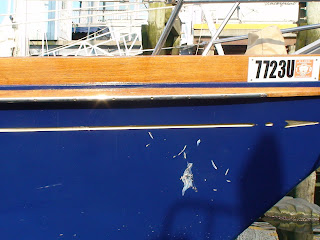
Gees, Louise! Still not good at keeping this blog up regularly, but I should be getting better at it now since work on the boat is pretty much done. Guess I will start with an overview of our trip south to-date from Connecticut. Nothing too exciting really. The good thing was that we were able to keep to a fairly tight schedule to get to Annapolis without having to push too hard at any point. We spent a couple of nights at Brewer's marinas (parts of a chain of quite fancy marinas in New England). The folks at the marina in Plymouth, MA where the paint job was done gave us a 'Gold Card' that included 6 nights free docking at any of their marinas. Not too shabby since it would have cost us something like $180 a night to stay at these spots. We would have been fine without the card and anchored but it was a nice change.
We spent one night at Liberty Landing Marina in Jersey City, our home for almost a year and half. In fact, we tied up in the dock that would have been ours if we had stayed there - just one spot in from the T-dock at the end. Much (much!) easier to get in and out there. It was great to spend some time there with our friends.
The next day we left to do the Jersey coast. There are only a couple of safe inlets that sailboats can use along this 100+ mile section and the only one placed about halfway (Manasquan) is not really that nice so most people do an overnight. We had to motor until about 6 pm because the wind was on the nose but the coast slips away to the west a bit further south and we had a marvelous sail all night. Our original plan was to stop at Cape May, NJ which is at the opening to the broad and shallow Delaware Bay that leads to a sea level canal that connects to the north end of Chesapeake Bay, but when we got there the conditions were fine to keep going - the beginning of a favourable tide (essential for this 50 mile stretch) with a light following wind. We had to motor, but at least we got this generally unpleasant stage of the trip out of the way. The other problem with going up Delaware Bay is that you are going north rather than being able to watch the latitude numbers on the GPS creep constantly south.
Our next stop, not altogether uneventful, was at a small town called Chesapeake City on the canal. This is a pretty little town that dates from the building of the canal in the 1840s and we ended up there for two nights. When we tried to leave after one night there we had the smell of rubber smoke and no charging from the engine alternator. The mechanic we were able to get was an electrical specialist and he took the alternator back to his shop and showed up next morning with everything fixed. The biggest problem was that the ground wire going to the voltage regulator was defective. It looked fine on the outside but there was a short inside the insulation.
Fixed alternator installed we tried to leave shortly after only to find that there wasn't really 6 to 7 feet of water at the entrance to the basin as we had been told. With our 4'10" draft we were stuck and had to wait for an hour or so until the tide provided the extra foot or so of water we needed. The delay meant that we did not get to the outer anchorage in Annapolis until it was almost dark.
A short day from there brought us to the Rhode River (small bays there seem to be all called 'rivers' - and the smaller side bays are called 'creeks' even though there is no flow through either). We anchored, with about 70 other boats, off a very large YMCA camp that was the location of the SSCA Gam. This was a terrific meeting with numerous speakers on topics like diesel maintenance, safety, marine weather and so on. The speakers were really good and hit the right tone for audiences that were really quite knowledgeable to start with - for example, the speaker on safety focussed on attitudes toward safety rather than what equipment you might need. This was my first time at such a meeting and it was most interesting as you learned about other people, their travels and boats and exchanged 'boat cards' (picture business cards for boaters).
After the Gam we had planned to cruise around the area before going to Annapolis to get a spot before the boat show but several people said you had to be there very early to get a decent place to anchor and that some prime areas were almost full. Soooo, we went back to Annapolis to anchor in Back Creek - a long narrow bay lined with docks on both sides. It was a bit crowded already but we found a place to anchor. The problems were two-fold. One was the every day more and more boats arrived and tried to anchor in places where there really were not places big enough to anchor. The other is that the holding ground was very bad; about as bad as any that I have ever seen. It has a soft, silty bottom that is used for anchoring so much that it has no particular ability to hold an anchor. This was only made worse by the fact that people were not using enough scope (anchor line length) because of the restricted space.
I made a command decision that the admiral (and budget secretary) was not pleased with at first, to take a permanent mooring while one was still available. This got us off to a corner of Back Creek with anchored boats only on one side of us (about 120 degrees of arc). This proved a good move a couple of days later when the winds came up and anchored boats started dragging in every direction. We helped several other people tie up one boat to some pilings after it dragged (the owner was away doing boat show preps). I think there were about 6 dinghies there with people pushing like mini-tug boats and running lines here and there. One boat near us spent the entire day reanchoring and then dragging and then reanchoring again (at least 6 times in total). It seemed like almost every anchored boat dragged at some point. Fortunately this happened during the day.
Finally the boat show came and we spent two days there looking at boats and buying stuff. We have friends from Jersey City who are considering a new boat in the 50 to 55' range and they asked for a second opinion on several. It was really fun to look at boats that cost in the $1.2 to $1.4 million range seriously and consider which might be best for an actual purchase. BTW, if anyone is making up their Christmas lists after winning a large lottery a Discovery 55 under my tree would be much appreciated http://www.panoscope.co.uk/projects/discovery55/. The two boats pictured are (left) a Friendship 40 - one of the new breed of 'daysailors' that are designed to sleep two and party a whole bunch of people. They do not clutter up the deck with things like lifelines that would destroy the appearance of the boat. It really was a gorgeous boat with an amazing standard of finish. It is about $1.5 million. On the right is an Oyster 70 with June added for size comparison. Don't know how much it might cost, but if you have to ask you obviously can't afford it. I did ask for the Friendship and I obviously can't afford it either.


We continued our own, personal economic stimulus package at the show buying some (more) charts, an AIS unit, a pressure cooker, and inflatable PFD/harness. We also bought a used sewing machine at the Gam - a very old, small, heavy-duty unit that can be plugged in or powered manually. These old machines are quite prized since they are so rugged and simple compared to the modern ones that make fancy stitches but are quite flimsy.
After the show we went to what are probably the most famous cruising destinations in the area, under the (correct) assumption that they would not be too busy this late in the season. These included St. Michael's and Solomons in Maryland and Deltaville in Virginia. In St. Michaels we had to replace the raw water pump on the engine. One night at dinner when it was very quiet I could hear water trickling somewhere. A short search found that the shaft in this pump was loose in its bushings and there was a steady drip of water coming in. We had two spare pumps on board from a

previous owner (does this indicate that this is a common problem?) and were able to fix this ourselves. When we had everything apart we al

so replaced the rubber impeller inside the pump that was starting to fail. The pictures show part of the historic district in St. Michaels and June 'tonging' for oysters at the excellent marine museum also in St. Michaels.
We ended up in Solomons for five nights in a very snug anchorage with nasty weather as the frontal systems just sat there for days. It was cool (yea! for the Espar heater) with frost warnings away from the water, windy (a couple of days with gale warnings) and very rainy. We had a lot of condensation to deal with since it was cool outside and the humidity was close to 100% for days. After about three days when the rain let up briefly we dinghied into the town and found lots of other sailors in their foul weather gear wandering around.
At Solomons we had our first significant exposure to the US military since it is adjacent to the Patuxent Naval Air Station which, I think, was the setting for the movie Top Gun (no sign of Tom Cruise though, although apparently he has bought a summer home in the area). There were a number of interesting planes coming and going including F18s (I think) and lumbering ones with huge disc-like radar antennae on top. As we were heading south from here we heard two sonic booms directly over us. Seems like some of the pilots could not resist the temptation - they were very loud indeed and we were a bit forewarned as someone had heard an earlier one and was talking about it on the radio.
Next we went to Norfolk, VA to get our watermaker fixed. We spent the first night in the area in an anchorage called Willoughby Bay that was right next to the Norfolk Naval Base, largest naval base in the world. We are adjacent to the air section and there were numerous helicopters doing a variety of training exercises. Some were doing practice landings and takeoffs and swinging just over heads in between each. Not very quiet but an interesting change from the idyllic settings of most of our anchorages. The sun also set over the nearby aircraft carriers (lower left in picture). The nearest carrier was the USS Harry S. Truman. It is more than 100,000 tons and carries a crew of almost 6000. You really notice the naval presence on the VHF radio. There was a Securite call asking all boats to stay 9 nautical miles from a particular location since 'Warship 94' was conducting live fire exercises. Also when a naval ship is moving in the port there are reminders from the Coast Guard that any vessels with 500 yards of the ship are subject to the use of force, "including deadly force". On the way out of the port we were closer to one ship than that, but the channel was just not that wide and there was a tug and barge even closer.


The next day we moved to Portsmouth, VA (across the river from Norfolk) where the watermaker company is located. The watermaker uses reverse osmosis to remove the salt from sea water. This requires sophiscated filters and a high pressure pump. Our unit had not been used for q

uite a few years and I was afraid that the RO filters might have degraded in storage (they are quite costly). At the boat show, the company rep said I should give the unit a go and that the worst that could happen is that it would not work. We tried a couple of times without success. The technician came to the boat and worked for an hour or so and got it working -- and did not charge for the service call. We only paid for the spare parts that we bought for the unit (basically a variety of filters). The watermaker is not an essential item but it is nice to have since water in the Caribbean can be quite costly (as much as $1 a gallon), may be of dubious quality since it is mainly just trapped rain water, and may not be available if there has not bee much rain. We should be able to produce about 10 gallons an hour but have to run the generator to power it (the pump is 110V AC) so the water is not free. In this photo the watermaker is everything in the left 3/4 of the image (there are some filters and valves in another location. The two white cylinders (about 20" long) are the actual RO elements. The motor is the large grey item in the center of the picture. The high pressure pump is the black box to the left of the motor (above one of the white cylinders).
Our final move was to a very small marina in Mobjack. VA. This marina is owned by someone who also owns a Bristol 45.5, although his has been extended to about 47' so it is really more like a Bristol 47.7 which is just a 45.5 with an extended transom and a bigger aft cabin. We motored almost all of the way there because there was no wind at all. In the last hour or so the wind came up and was blowing 25+ knots by the time it was dark. When we tried to turn around in the harbour we ran gently aground and could not get off under our own power. We had two choices, wait for the high tide to return - this would not have been until after midnight or use our Boat US membership to get a tow. For those who do not know this organization it is like AAA/CAA roadside assitance for boats. The first boat they sent, from a nearby location just was not big enough to do much, but a second boat from an hour or so away did the trick. The operator was very skillful and knew exactly what to do. It was fascinating to see that the secret was not so much to use his 300 hp to pull us out of the mud. Rather it was to use the propwash from his engine to push mud away from our keel and essentially deepen the water. He tied a tow rope to our bow (quite close actually) and used about 2/3 throttle to great an enormous wash that he directed down either side of our keep by having his boat swing across our bow. It was nice to get a shower and get to bed early rather than being up for much of the night getting off - especially since we had to drive to Toronto the next day.
I am writing this in Canada on Friday, the 30th of October. We are going to Virginia on Sunday. Yesterday the long-range forecasts looked really good for us to depart for the US Virgin Islands on Monday, the 2nd. The forecasts today have changed quite dramatically as a new low pressure area seems to be forming on Monday/Tuesday in and off the Carolinas. The result would be strong north and northeast winds into the Gulf Stream. At best this would be very uncomfortable; at worst, quite dangerous. Once we get there we just have to wait.